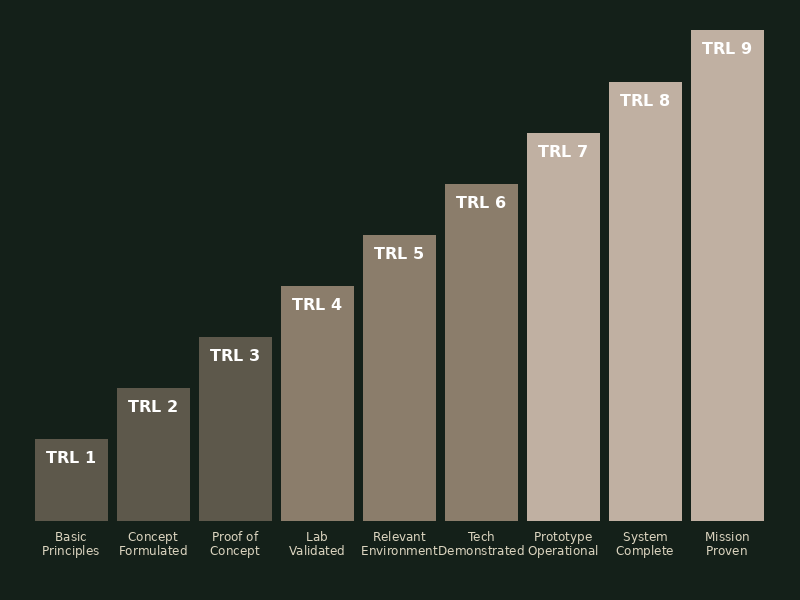
Across multiple universities, sectors, and funding programmes, the same patterns repeat. Technologies leave the lab with strong technical foundations but enter the market with critical gaps already baked in. Regulatory pathways are assumed rather than defined. Manufacturing is deferred until funding appears. Commercial responsibility is distributed across committees, advisors, and time-limited programmes.
Everyone contributes insight. No one owns the outcome.
The valley of death is really a gap in ownership
The phrase “valley of death” has become shorthand for the period between proof of concept and commercial traction. The framing is not wrong, but it is incomplete. What is commonly described as a funding gap is more accurately a responsibility gap. Technologies fall into it because no individual or organisation is mandated to carry them across.
Universities are optimised to create knowledge. Funding programmes are optimised to distribute risk. Advisors are optimised to provide guidance. None of these structures are designed to carry responsibility for commercial success. When every actor is doing what they are optimised for, the venture still ends up stranded, because carrying a technology from lab to market was not in anyone’s job description.
This is not a criticism of universities, TTOs, or founders. It is a structural observation about how industrial innovation is organised.
Why the pattern repeats
The sequence is predictable. Early enthusiasm from the research team and the TTO gives way to extended timelines as the commercial case takes shape slowly. Ownership of outcomes dilutes as more advisors, committees, and funding programmes become involved. Decision making slows because no one has both the mandate and the context to make a call.
What is missing is not effort, intelligence, or intent. It is a single point of accountability for what happens next.
This is the same problem an early-stage founder solves by the simple act of incorporating a company: the company becomes the accountable entity. Everything before incorporation, and much that happens immediately after, exists in an accountability vacuum by design.
What industrial commercialisation actually requires
Successful ventures address regulatory positioning early, not after technical validation. Manufacturing realities shape technical decisions from the outset. Commercial pathways are designed alongside development plans, not added later. Most importantly, responsibility for outcomes is clearly assigned and continuously held. When these conditions are absent, failure is not accidental. It is predictable. These observations are not theoretical. They come from repeated exposure to the same failure modes across different institutions, sectors, and funding environments. The details vary. The structure does not.
What this means for researchers, TTOs, and founders
For researchers, scientific strength alone does not build a venture. The commercial work is not downstream of the research. It shapes what the research should actually produce. For TTOs, the choice is between supporting many technologies at shallow depth or supporting fewer technologies with the integrated commercial discipline that industrial commercialisation requires. Most try to do both and achieve neither.
For pre-spinout and spinout teams, the question to ask before incorporation is who owns the commercial outcome, what they are accountable for, and whether their capability matches the size of the job.
What Hatch exists to do
Closing the ownership gap requires more than additional programmes or better advice. It requires a different operating model, one that treats commercialisation as an integrated, accountable process rather than a sequence of hand-offs.
Engineering and commercial strategy in the same room from day one, held by the same team, with a named set of outcomes and someone responsible for delivering them.
That is the gap Hatch exists to own.