UK robotics adoption is about to gain its most important piece of infrastructure yet, and almost nobody is describing it the right way.
Later this year the government will fund a network of Robotics Adoption Hubs, backed by around £40 million, and above them a Central Convening Body with up to £2 million to coordinate the whole network. The programme runs to 2030. Most coverage has framed it as another funding pot. We think that misses the point. The convening body could be the most powerful lever in UK industrial policy for years, as long as we build it as air traffic control rather than a help desk.
The problem was never the robots
Here is the uncomfortable truth. The UK does not have a robotics problem. It has an adoption problem.
Our universities produce world class robotics research. Our startups win awards. And yet the UK has the lowest robot density in the G7, at roughly 100 to 120 industrial robots per 10,000 manufacturing workers. South Korea runs at more than 1,200. Singapore sits above 800. Germany is near 450. We do not even make the global top ten. In a recent year France grew adoption by 13 percent and Italy by 8 percent, while the UK managed just 3 percent. By almost any measure, UK robotics adoption is the slowest in the group.
The cost of standing still is not abstract. Analysis suggests that matching the most automated economies could lift productivity by more than a fifth and add around £150 billion to GDP by 2035. Better still, the value reaches into sectors most people never link with robots. Construction alone could be worth £46.8 billion, health and social care £34.2 billion, energy and infrastructure £23.4 billion.
So the technology exists, the money exists, and the prize is enormous. What has been missing is coordination.
What air traffic control actually does
Think about how aviation works. Individual pilots are highly skilled. Individual planes are extraordinary machines. Yet without a control tower routing traffic, sharing information and stopping everyone from solving the same problem in isolation, the whole system seizes up.
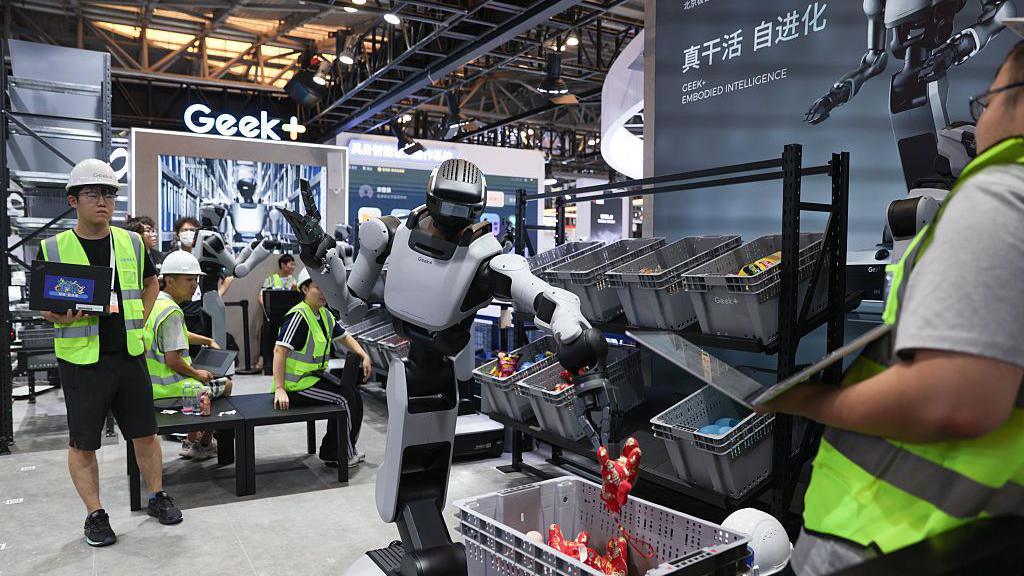
Right now UK robotics adoption looks like a sky full of talented pilots and no tower. A hospital trust runs a pilot on surgical robotics. A logistics firm forty miles away solves an almost identical picking and handling challenge from scratch. Meanwhile a farm trials autonomous harvesting and hits the exact knowledge barrier a warehouse operator cracked two years earlier. Nobody is talking to anybody, so every project pays the full cost of learning.
A convening body built as air traffic control does three things a help desk never could.
First, it routes capability across sectors, not only within them. The gripper that handles soft fruit is a close cousin of the one that handles surgical consumables. The navigation stack for a warehouse also works on a construction site. The body should actively move proven solutions between industries that would never otherwise meet.
Second, it holds the map. It knows who has tried what, what failed, and what the real payback period looked like once the pilot ended. That independent, honest picture is exactly what a business owner cannot get from a vendor trying to sell them a machine.
Third, it clears the runway. It connects end users with integrators and finance providers, and it flags regulatory and skills bottlenecks before they ground a project. In practice, adoption stalls far more often on financing and confidence than on engineering.
What the leaders can teach UK robotics adoption
Every country ahead of us treated adoption as a system, not a shopping list.
South Korea did not simply buy robots. It committed to training tens of thousands of people to run automated systems, and today reports effectively no skills shortage in technical and digital innovation. Firms adopting smart technology there see productivity rise by about a quarter and defects fall by more than a quarter. Singapore grew its density by double digits year after year through relentless, coordinated effort. Germany paired its industrial base with active campaigns to attract and keep talent.
The pattern is clear. The winners did not out invent everyone. They out coordinated everyone. They made adoption easy, cheap to learn and safe to try.
That is the opportunity in front of us now. If the hubs become thirty separate fiefdoms and the convening body becomes a newsletter, we will have spent £40 million confirming what we already know. If instead we build a real control tower, one that moves knowledge and capability across sectors at speed, UK robotics adoption can finally start closing a gap that has held British productivity back for two decades.
Where Hatch sits in this
This is the work we care about, and we know this world from the inside. Our team has developed remote handling robots that operate from kilometres away in some of the most hazardous environments on earth. Helping innovators and early stage companies turn strong technology into real adoption is the whole point of what we do at Hatch. The founders building the next generation of robotics do not need another pilot that goes nowhere. They need to be plugged into the tower.
The hubs and the convening body are a rare chance to fix the layer that has always been missing. So let us not waste it on a help desk. Let us build air traffic control.
If you are a founder, funder or sector leader thinking about how to plug into the new robotics hubs, we would love to talk.