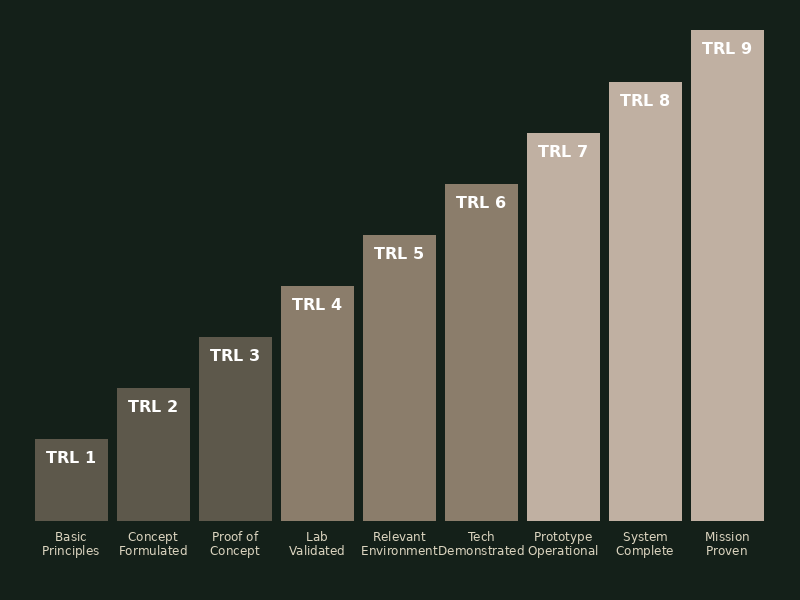
A TRL 7 demonstration is not an investment thesis. Neither is a peer-reviewed paper, a patent filing, or a successful proof of concept. These are necessary conditions. They are not sufficient ones. The question a deep tech investor asks after seeing the technology is always the same: can this become a business?
The TRL trap
Technology Readiness Level was designed for government procurement, specifically for aerospace and defence applications. Its purpose is to assess whether a technology is ready for a specific use in a specific context. It says nothing about markets, customers, business models, or routes to scale.
Deep tech ventures that present investor readiness as a function of TRL are solving the wrong problem. Moving from TRL 4 to TRL 7 advances the technology. It does not advance the commercial case. The two development tracks are parallel, not sequential, and treating them sequentially is where most of the value between lab and market is lost.
What commercial readiness actually looks like
Sophisticated deep tech investors evaluate four things in parallel with the technology, and the weakest of the four tends to set the valuation. The first is market validation. Not a TAM calculation derived from a market research report, but named prospective customers, documented conversations, evidence of willingness to pay, and a clear articulation of the problem the technology solves in the language of the buyer, not the language of the lab.
The second is beachhead clarity. Not a long list of possible applications, but a single, specific, defensible first market: the segment where the technology is most differentiated, the buyer is most accessible, the sales cycle is shortest, and the first customer can serve as a credible reference for the second.
The third is coherence between the IP position and the commercial strategy. The IP has to protect what the business model requires it to protect. Investors look for this coherence because its absence is a reliable predictor of value leakage as the business scales.
The fourth is team completeness. Engineering credibility is table stakes in deep tech investment. What is often missing is commercial credibility: evidence that the team can sell, not just build, and that the commercial strategy has been tested by someone who has done it before.
The timing problem
Most deep tech ventures approach investors when the technology is ready. The logic is sequential: complete the technical development, then address the commercial questions. This is the standard failure pattern.
By the time the technology reaches a demonstrable stage, the commercial development work should already be well advanced. The investor conversation is more productive when the venture arrives with market validation already conducted, a beachhead already defined, a manufacturing conversation already started, and a commercial narrative already tested against prospective customers.
The ventures that close Series A rounds in defensible positions are the ones that ran commercial development in parallel with technical development, not after it.
What investors see when the commercial case is underdeveloped
An engineering story and a commercial story built on different timelines by different people produce a gap that experienced investors identify immediately. The engineering section is detailed and credible. The commercial section reads as derivative: a large addressable market, a list of possible applications, a vague route to scale.
That gap is not only a presentation problem. It is an operating model signal. An investor looking at a venture where the commercial case lags the technology is looking at a venture that will continue to operate that way after the cheque is written. The pricing of that signal is reflected in the valuation terms and in the conditions attached.
What investor readiness actually requires
The checklist lives in most investors’ heads even when they do not articulate it. Named first customer or a credible letter of intent. A manufacturing partner conversation already started. IP strategy coherent with the business model rather than parallel to it. A clear route from the current stage to the next investment milestone, measured in commercial events, not technical ones. A team that has both the engineering depth and the commercial judgement to make the decisions that follow funding.
None of this requires the technology to be at TRL 9. It requires the commercial development to have started at the same moment as the technical development.
The Hatch engagement model
Engineering and commercial development at Hatch run in the same room from the first conversation. Market validation is not downstream of technical validation. Manufacturing feasibility is not a post-funding problem. IP strategy is not a legal question separated from the commercial one.
The ventures that arrive at an investor conversation with all four dimensions developed in parallel are the ones that close on terms reflecting the strength of what has been built, not the weakness of what has not yet been addressed.